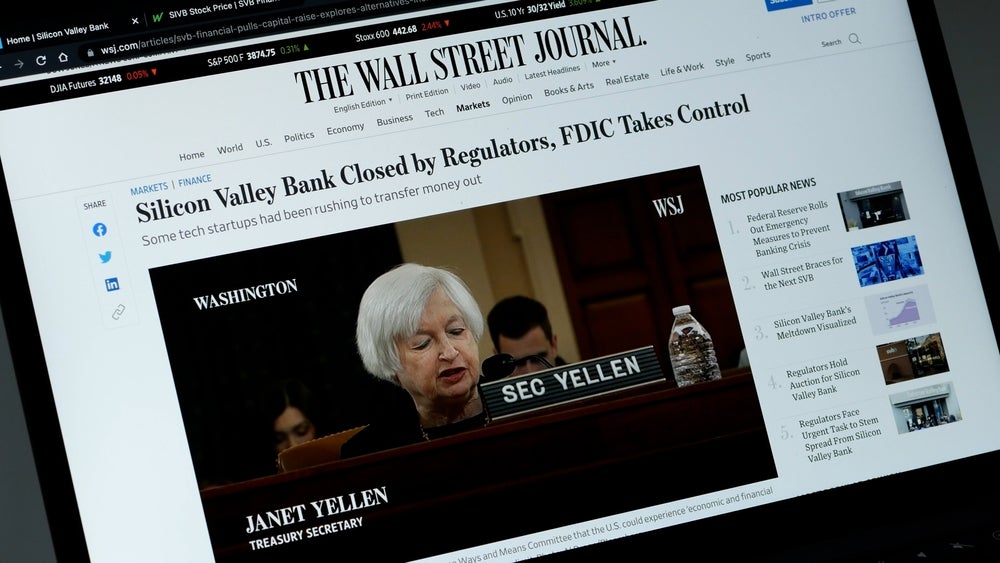
Silicon Valley Bank (SVB) was the third-largest bank failure in US history and dominated the business press in March 2023.
Some bank failures resemble a slow-motion car crash. Not SVB. It collapsed in March 2023 in a little over 48 hours. And the reasons for the failure?
Go deeper with GlobalData


Access deeper industry intelligence
Experience unmatched clarity with a single platform that combines unique data, AI, and human expertise.
It was really a classic case of a bank run but with a twist. It was however some bank run-around $42bn or thereby. And the modern twist took the form of client panic, fuelled by social media, following release of the bank reporting a loss of $1.8bn on 8 March 2023.
On the next day, the bank’s share price collapsed by 60%. Depositors, while relatively few in number, were vocal and in many cases high profile, since many clients were venture capital firms and tech start-ups. They were also depositors for whom the FDIC’s protection fund guarantee of deposits up to $250,000 offered inadequate comfort.
By 10 March, SVB was placed under the receivership of the FDIC.
Stas Melnikov, head of quantitative research and risk Data Solutions at SAS speaks with RBI editor Douglas Blakey
A big week for banking news got bigger just two days later, when state officials closed Signature Bank. The New York based bank had, for reasons best known to itself, courted cryptocurrency deposits and uninsured deposits at scale.
12 March was quite a day and witnessed the FDIC, the Treasury Department and the Fed acting in concert and at speed. Specifically, they announced that depositors in Silicon Valley Bank and Signature Bank would have all of their deposits protected, even those in excess of the $250,000 limit. This did the trick and regulators succeeded in restoring wider confidence in the US financial system.
As the third anniversary of the SVB collapse approaches, it is timely to ask if lessons of the failure have been learned. Or is there a danger that many of the issues that led to the collapse, still exist?
Stas Melnikov, Head of Quantitative Research and Risk Data Solutions at SAS, tells RBI: “We have a number of structural issues that existed before and still exist. We had a decade of super low interest rates that pushed many banks into a significant asset liability mismatch from an interest rate risk perspective. Just functionally, there wasn’t really any other way to make money for a smaller community or regional bank. That interest rate mismatch is still in the books. The interest rates are high. They always had a view that inflation is stickier than the market has expected. We have written extensively about it for the past two years, and know that the rates are not coming down, and likely will stay elevated for longer. That means you still have unrealised losses sitting on sitting on the balance sheets.
Fragmented systems remain a danger
” At the same time, the retail deposit concentration has not changed in any meaningful way. And you know, as much as I would like to see improvement in processes, there’s still the same kind of fragmented systems and that you know is still a danger.”
Arguably, on the tech side, banks simply have no excuse. Software, such as SAS risk management and analytics solutions, help foster a risk-aware culture, optimise capital and liquidity and meet regulatory requirements while enhancing efficiency and transparency. If any bank fails to balance short- and long-term strategies as they navigate the landscape of financial risk, it is not because of a lack of proven technology in the market.
Says Melnikov: ” You should have systems that are able to quantify risks quickly. They should be integrated, because financial risks don’t exist in isolation. At SVB, it wasn’t just interest rate risk. It was an interest rate risk that turned into a credit risk that then turned into a liquidity risk. So all of these things are highly interconnected. You need to have this integrated balance sheet management perspective. That means breaking down the silos between credit risk, liquidity and interest as well as the capital to optimise the funding.”
Speed is however, not sufficient. The integration has to be done in a traceable way and available for audit, so the bank can justify its actions and understand the assumptions that went into the calculations,
“So there’s a lot of nuance that goes in there, beyond the surface of just the speed of integration and traceability. And I think that that realisation is still not quite there. Silicon Valley was such a blatant example of how things could go wrong. While it should be serving as as a warning [some may say], oh, well, it is not going to happen to us. We don’t mismanage risk like that. We got it covered.
“In some ways, it actually prevented many of the institutions talking about the interest rate and liquidity risk. At the end of the day, the banking system is built on trust. No matter how well capitalised a bank is, if the trust is broken, the bank is done. So then you don’t want to be that bank that brings up those topics, because there could be a media effect. That creates a fragile environment, and that environment is still there, because we still have those unrealised losses. “
But do the banks get it? Are they willing to invest in the right technology and allocate sufficient budget to optimise their risk and data analytics strategies?
‘The G-SIBs get it’
“The latest earnings are looking good. Do banks get it? It really depends which banks. I think that the large [Globally Systemically Important Banks] G-SIBs get it, but not in an equal way. And I don’t want to comment on the individual names, but I think by and large, there is a recognition of the importance of integrated balance sheet management. And many of the large banks have gotten, if not all the way there, most of the way there.
“So, in that regard, investment in technology, investment in automation, investment in AI, is paying off. We have the large, sophisticated G-SIBs with the money to invest in aligned risk management processes and the ability to handle macroeconomic shocks due to their diversified business model.
“There is investment, investment is going in the right place. They’re doing great. They’re adopting technology. They’re doing all the things that you would want to be doing.
“But then on the other side, you have the smaller regional and community banks that are just struggling under the burden of regulation. They still have to do all the regulatory reporting and that is expensive for them. It leaves very little funds to do internal risk management. Forget about integrated balance sheet management. A sophisticated bank can be doing daily risk management, real time, hedging, all of this cutting-edge stuff, whereas a small regional bank can be running scenario analysis once a year or once a quarter. And in a batch process, that takes weeks to interpret afterwards. Yet at the same time, they are the most vulnerable. They rely on concentrated retail deposits. Their loans are to the community and they perform such an important function.
The most trusted name in analytics
So structurally, you have this divergence. And I think that that’s a very concerning one that warrants a lot more attention than what we’ve been seeing.”
On SAS’ proposition, Melnikov says that it has evolved with time but that SAS remains the most trusted name in analytics.
“We have been for many decades and will continue to be. And then there’s other aspects that are also now becoming more important, such as productivity and performance. Our systems are designed with deep domain expertise. They optimise the time to decision, time to value. You have to spend less time coding. And now, we do see more and more movement to the cloud because of maintaining internal server infrastructure and keeping up with the latest security patches and everything else that is happening in IT world.
It is becoming costly, especially for the smaller firms. So being able to [offer] SAS hosting that takes care of everything is a great advantage. And it’s also having the whole product stack. Having everything [means] data acquisition, quality control, model, development, estimation and then implementation.
SAS ‘democratises advanced analytics’
“Development and implementation are where all the skeletons are buried, and that’s usually a very difficult and complicated and error prone process. Whereas we automate that and not just a generic model. We actually have the domain-specific models with financial services expertise baked in. We have credit scoring models. We have behavioural modelling frameworks that are systems of models that typically would be out of reach for a smaller institution to estimate themselves. Where you go with us, all we need is data. Everything else, we guide you through and have the experts to help you put that all into implementation. So in many ways, it democratises advanced analytics. I think that’s what I am really super proud of. That particular aspect of what we have to offer kind of levels the playing field. We woefully need that because we do need to make sure that all the institutions are thriving, not just the very large ones.”
.